
| Doon Cheesewood |

|
 |

|


| File size | 312947 |
| Original date | 4/7/14 1:51 PM |
| Resolution | 1440 x 1080 |
| Flash | Flash fired, return detected, auto |
| Focal length | 48.0mm |
| Exposure time | 1/125s |
| Aperture | 4.8 |
| Focus Distance | |
| Metering Mode | Multi-segment |
| Camera make | NIKON CORPORATION |
| Camera model | NIKON D80 |
| Sensor type | OneChipColorArea |
 |
 ative ative |
 |
 |
Photo: |
Botanical name: Pittosporum eriocarpum Family: Pittosporaceae (Pittosporum family)
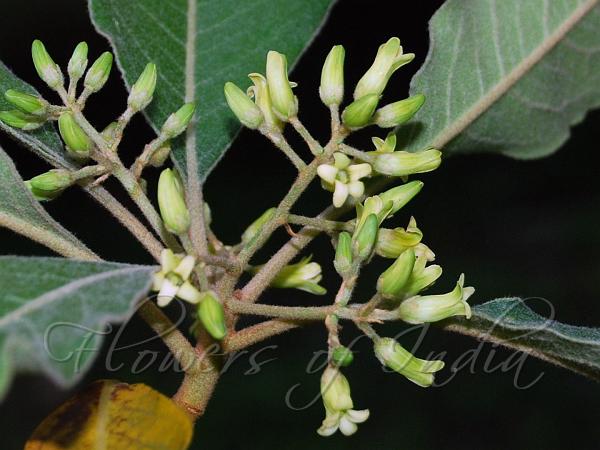
Doon Cheesewood is an evergreen shrub or small tree, easily recognized by its velvety young leaves and fruits, and confined to a small region of Uttarakhand. It is highly threatened. The tree grows up to 6.5 m tall with a girth of 1.2 m, though cultivated specimens may be larger, while plants in poor conditions remain shrubby. It has spreading, nearly whorled branches, stout velvety twigs, and smooth silvery-grey or pale-brown bark with small raised warts. Leaves are broadly obovate to oblong, 6–18 × 3–9 cm, leathery, and velvety when young, becoming glossy green at maturity, with 8–16 pairs of lateral nerves and stalks 1.0–2.8 cm long. Flowers are pale yellow, 7–8 mm long, in short clusters on 4–6 cm peduncles. Fruits are capsules, 0.8–1.6 cm across, velvety when young and smooth when mature. Once heavily used as fodder, overharvesting has endangered the species. Doon Cheesewood is found in NW
Himalayas, Dehradun, Mussoorie hills, Jeullikot in Nainital, Chamba,
and Mandi distt in Himachal. Flowering: March-April.
Medicinal uses: The bark is aromatic, when
freshly cut, and is said to possess narcotic properties. It was used
locally in chronic bronchitis and as an antidote to snake poison. The
plant yields an essential oil, which was used as a tonic, stimulant,
and was considered specific for certain skin diseases. The oil was also
applied by natives as in rheumatism, chest affections, sprains and
bruises. Wood was mainly used as fuel and also for making small toys.
The bark is aromatic, when
freshly cut, and is said to possess narcotic properties. It was used
locally in chronic bronchitis and as an antidote to snake poison. The
plant yields an essential oil, which was used as a tonic, stimulant,
and was considered specific for certain skin diseases. The oil was also
applied by natives as in rheumatism, chest affections, sprains and
bruises. Wood was mainly used as fuel and also for making small toys.
Medicinal uses:
The bark is aromatic, when
freshly cut, and is said to possess narcotic properties. It was used
locally in chronic bronchitis and as an antidote to snake poison. The
plant yields an essential oil, which was used as a tonic, stimulant,
and was considered specific for certain skin diseases. The oil was also
applied by natives as in rheumatism, chest affections, sprains and
bruises. Wood was mainly used as fuel and also for making small toys.
| Identification credit: Amber Srivastava | Photographed in Sahastradhara, Dehradun, Uttarakhand. |
• Is this flower misidentified? If yes,